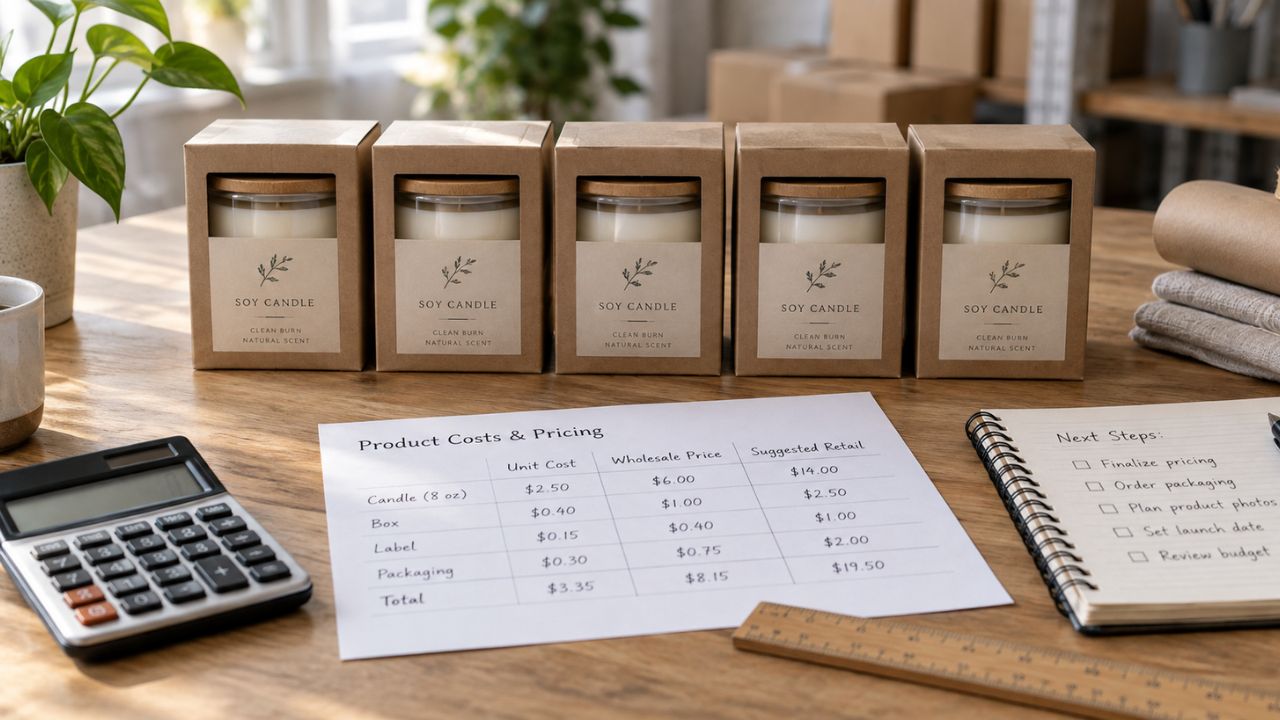
To price wholesale products for retailers, start with your true cost per unit. Then set a wholesale price that leaves you a profit and still lets the store mark the item up to a shelf price shoppers will pay. A common starting point is keystone pricing: the retailer pays about half of the suggested retail price and doubles it on the shelf.
If you only double your factory cost and call that “wholesale,” the store may have no room left. If you only copy a competitor’s MSRP, you may sell every case at a loss.
This guide walks US makers and brands through landed cost, the two formulas buyers expect, a full worked example, and simple volume tiers you can put on a line sheet.
How to Price Wholesale Products for Retailers
Use two checks on every SKU.
From your cost (protects you):
Wholesale price = Landed cost per unit ÷ (1 − your target wholesale margin)
From the shelf (protects the retailer):
Wholesale price = Suggested retail price × (1 − retailer margin)
Both numbers should be close. If the cost-based price is higher than the shelf-based price, the product is too expensive to make for that retail channel. Cut cost, raise MSRP, or keep the item on your own website.
Wholesale price is what the retailer pays you per unit, usually on a case or minimum order. It is not the price a shopper sees.
First add up landed cost, not just the factory invoice
Landed cost is every dollar required to get one sellable unit ready to ship to a store.
Include:
- Materials, ingredients, or the supplier invoice
- Direct labor and contract manufacturing
- Packaging, labels, inserts, and case packs
- Inbound freight, duties, and customs if you import
- Shrink, samples, and units you cannot sell
- A small share of warehouse handling if you can measure it
Do not stuff your entire rent and salary into one candle. Those are overhead. Cover them with the margin on all wholesale units, then confirm the SBA-style break-even: fixed costs divided by the dollars left after variable cost on each wholesale sale.
If a case of 12 costs $96 delivered and two units are unsellable, your landed cost is $96 ÷ 10 = $9.60, not $8.00.
Markup and margin are not the same
This mix-up causes bad wholesale quotes.
- Markup is profit divided by cost. Cost $10, sell $15, markup is 50%.
- Margin is profit divided by selling price. Same numbers, margin is 33%.
A 50% margin means you keep half of the wholesale price. That is a 100% markup on cost. Retailers talk in margin. If a buyer says they “need 50 points,” they mean 50% of the shelf price, not a 50% add-on to your cost.
Keystone pricing, the default many stores still use
Keystone means the retailer doubles what they pay you. Wholesale is 50% of MSRP. The store’s margin is 50%. Your wholesale price is half the ticket.
Example:
- MSRP (shopper price): $40
- Wholesale (store pays you): $20
- If your landed cost is $10, your wholesale margin is 50%
That two-step double (cost to wholesale, wholesale to retail) is why people say cost should land near one-fourth of MSRP. It is a planning rule, not a law. Apparel, gifts, and specialty shops use it often. Grocery and mass retail often take a smaller shelf margin and then ask for promotions, free fills, or delivery terms that eat more of your price.
Electronics, large appliances, and other high-ticket goods often sit below keystone because doubling wholesale would miss the market.
Cost-plus pricing when keystone leaves you short
Cost-plus starts with landed cost and adds the markup you need.
Wholesale price = Landed cost × (1 + markup %)
Same result as the margin formula if you convert correctly. A 40% wholesale margin is:
Wholesale = Landed cost ÷ 0.60
A $8 landed cost at a 40% margin is $8 ÷ 0.60 = $13.33 wholesale. If the retailer keystones that, MSRP is about $26.66. Round to $27 or $28 if that is how similar products are priced.
Choose the margin from your channel and overhead, not from a blog average. Many product brands aim somewhere in the 30% to 50% wholesale-margin band. High-volume, low-price goods run leaner. Handmade or low-volume goods need more. Treat those bands as a starting range, then test against real invoices.
Worked example: a $28 retail candle
You make a candle. Shoppers in boutiques like yours will pay about $28. Independent gift shops in your region usually want close to a 50% margin.
Step 1. Landed cost
| Cost piece | Per unit |
|---|---|
| Wax, wick, fragrance, vessel | $4.20 |
| Label and box | $1.10 |
| Contract pour and pack | $1.40 |
| Inbound supplies freight (allocated) | $0.50 |
| Unsellable units (5%) | $0.36 |
| Landed cost | $7.56 |
Step 2. Price from the shelf
Retailer margin 50%: wholesale = $28 × 0.50 = $14.00
Step 3. Check your margin
($14.00 − $7.56) ÷ $14.00 = 46% wholesale margin
That works for many small brands. Your profit per unit is $6.44 before overhead, freight to the store, and payment terms.
Step 4. Watch the trap
If landed cost were $14, wholesale at keystone would be $14 and you would earn $0. The store would still be fine. You would not. Raise MSRP only if the category can bear it. Otherwise cut cost or skip wholesale on that SKU.
Step 5. Quote the case
Pack 6 per case. Case wholesale = $84. Set a minimum order, such as 3 cases ($252), so picking and shipping do not erase the $6.44.
Build a simple tier sheet
Retailers expect a cleaner price when they buy more. Keep tiers wide enough that a small shop can start, and steep enough that a chain order is worth the extra work.
Example line:
| Quantity | Unit wholesale | Case of 6 |
|---|---|---|
| 3–11 cases | $14.00 | $84.00 |
| 12–23 cases | $13.00 | $78.00 |
| 24+ cases | $12.25 | $73.50 |
Recheck the lowest tier against landed cost plus outbound freight. A “win” on unit price is a loss if you absorb free shipping on a heavy case.
State freight terms in plain English. FOB origin means the store pays freight from your dock. Delivered or prepaid means you built freight into wholesale. Do not hide freight inside a discount. Buyers will ask.
MSRP, MAP, and your own website
Publish three numbers on the line sheet:
- Wholesale: what the account pays
- MSRP: the shelf price you recommend
- MAP (optional): the lowest price you allow a retailer to advertise
MAP is an advertising rule, not a promise that every store will sell at MSRP. It can reduce public race-to-the-bottom pricing. It does not replace a lawyer or a written policy. If you also sell direct to consumers, keep your DTC discount close enough to MAP that retailers do not feel undercut on launch day.
Terms that change the real price
The invoice unit price is not the final net.
- Payment terms. Net 30 is a short loan you fund.
- Opening order discounts. Fine for a first buy. Do not let them become the permanent price.
- Promotional allowances. A “scan deal” or 10% off invoice is a price cut. Subtract it before you celebrate margin.
- Returns and damages. Specialty accounts may send back unsold goods. Grocery may expect spoilage coverage.
- Free freight thresholds. Price the threshold so a full pallet covers the truck.
Net wholesale after those items is the number that must beat landed cost.
A practical sequence you can reuse
- Write landed cost for one unit.
- Pick a realistic MSRP from competitor shelves, not from hope.
- Subtract the margin your target stores expect. That is candidate wholesale.
- Compute your wholesale margin. If it is too thin, change cost or MSRP before you pitch.
- Set case pack, minimum order, and two volume tiers.
- Add freight terms and any MAP note.
- Run one sample order through freight and payment timing so the first retailer does not put you in a cash hole.
You do not need software for this. A one-page sheet with cost, wholesale, MSRP, and case price is what a buyer can work with.
FAQs About How to Price Wholesale Products for Retailers
Q. What is a good wholesale margin?
A. Many product brands aim for about 30% to 50% of the wholesale price after landed cost. The right figure depends on volume, freight, and overhead. A pretty percentage that ignores freight is not a good margin.
Q. Should wholesale always be 50% of retail?
A. No. Fifty percent of MSRP is the keystone starting point many specialty retailers use. Grocery, mass, and high-ticket categories often use a different split. Ask the buyer what margin their category needs, then test it against your cost.
Q. How do I price wholesale if I already sell direct to consumers?
A. Set MSRP from the price your own site can support. Give retailers a true wholesale discount off that MSRP. If your website constantly undersells the stores, accounts will stop reordering.
Q. Do I charge sales tax on wholesale invoices?
A. Many wholesale sales are resale and may be exempt if the retailer gives you a valid resale certificate. Tax rules vary by state. Confirm with your state’s department of revenue or a tax professional. Do not guess from this article.
Conclusion
You price wholesale products for retailers by pairing landed cost with a shelf price the market will bear. Use the margin formula to protect your profit, then check keystone or the store’s required margin so the retailer can mark the item up and still eat.
If those two prices disagree, fix cost or MSRP before you send the line sheet. Write one SKU this way today and use it as the template for the rest of the catalog.
Disclaimer: This article is general educational information for US makers and brands. Category norms, retailer terms, freight, MAP policies, and sales-tax rules vary and change. Examples are simplified. This is not accounting, tax, legal, or antitrust advice. Confirm figures with your costs, your buyers, and a qualified professional when you need advice for your business.