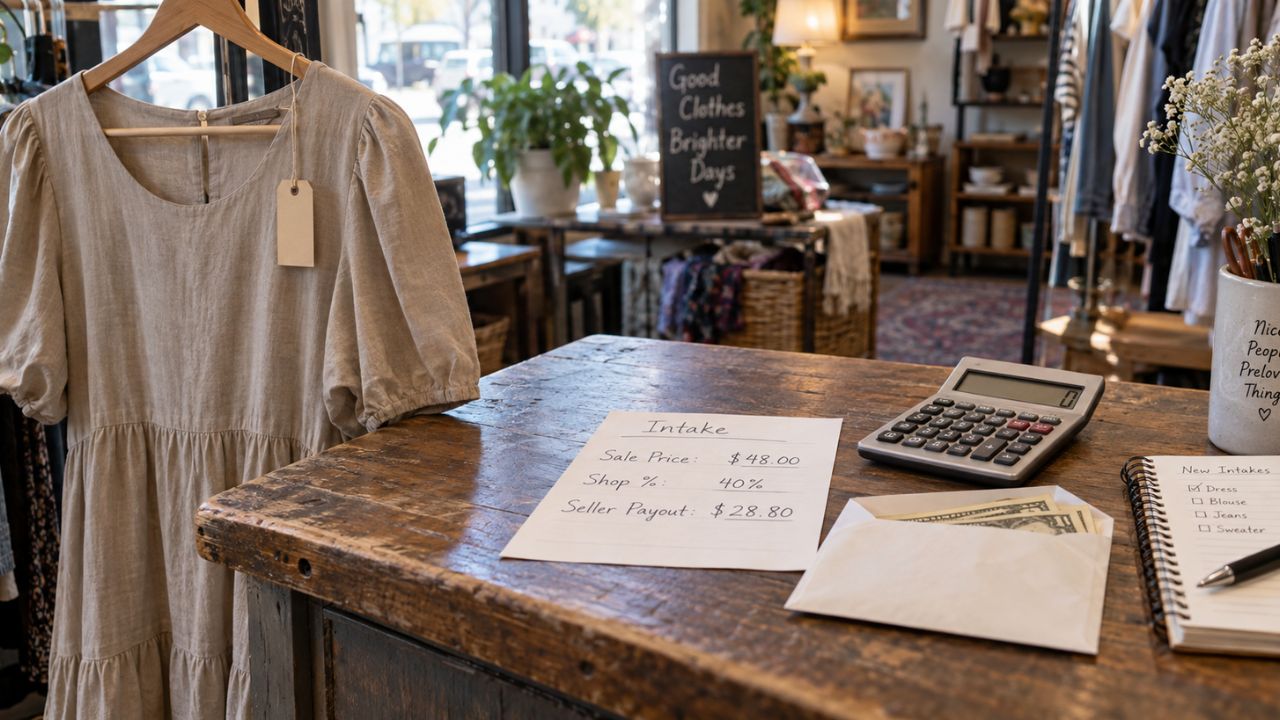
To calculate profit on consignment items, start with the price the shopper paid. Multiply by the share the contract gives you. Then subtract the cost of the item and any fees the agreement takes out. Do this only on pieces that sold. Unsold goods are not a loss on paper yet, but they are not profit either.
Consignment is not wholesale. The shop does not buy the item. You still own it until a customer pays. The shop earns a commission for space, staff, and the sale. That is why the ticket price can look healthy while your payout is thin.
This guide is for US makers and resellers who place goods in shops, and for shop owners who need the same math from the other side. You will get the formulas, a worked example, and the fee details that change the number.
How to Calculate Profit on Consignment Items
If you own the goods (you are the consignor):
Your profit = Your payout − item cost − your extra costs
Your payout = Final sale price × your percentage
If the contract splits net proceeds instead of the sticker price:
Your payout = (Final sale price − agreed fees) × your percentage
Final sale price is what the customer paid for the item after markdowns, before sales tax. Sales tax is not yours and is not the shop’s commission base.
Item cost is what you paid to make or buy that piece, including materials and a fair slice of your labor if you made it. Extra costs are what you spent to get it to the shop: gas, a shipping label, a special rack fee, or a pickup charge on leftovers.
If you are the shop (the consignee):
Shop profit on that sale = Shop share − card fees − bags and tags − any pickup or listing cost you agreed to cover
Shop share = Final sale price × shop percentage
The shop’s share is not net profit for the business. Rent and payroll still come out of all those shares added together.
Read the split in plain words
People say “60/40” and mean opposite things. Do not trust the shorthand. Ask: “What percent of the sale do I take home?”
Many US clothing and general resale shops keep about 40% to 60% of the selling price and pay the owner the rest. A 50/50 split is common. Some shops pay the owner 60% and keep 40%. Luxury or high-ticket pieces sometimes pay the owner more. Furniture and items that need delivery often leave the shop a larger share because handling costs more.
Write both percents on the tag math:
- Sale $80
- Owner keeps 50%: payout $40
- Shop keeps 50%: shop share $40
Tiered splits change the percent when the price crosses a line. A $40 blouse and a $400 bag may not use the same rate. Use the rate that applies to that sold price, not the price you hoped for on intake day.
The fee base matters as much as the percent
Ask what number the percent hits.
- Gross split. Percent of the ringing price. Simple. Card fees come out of someone’s share later, or the shop eats them.
- Net split. Percent after card fees, marketplace fees, or a listed prep fee. Your 50% of a smaller number is less than 50% of the tag.
A $80 sale with a 2.9% + $0.30 card fee leaves $77.38. A 50/50 split on gross pays you $40. A 50/50 split on net pays you $38.69. Same contract word “half.” Different cash.
Who pays the card fee should be in the agreement. So should who pays to ship an online order, who pays for a steamer or authentication, and whether a $2 intake fee comes off before the split.
Worked example: one jacket and one handmade candle
Resale jacket
You bought a jacket at a yard sale for $12. The shop lists it at $80. The split is 50/50 on the sale price. No extra fees. It sells at $80.
| Line | Amount |
|---|---|
| Customer pays | $80.00 |
| Your payout (50%) | $40.00 |
| Your cost | −$12.00 |
| Your profit | $28.00 |
| Shop share | $40.00 |
Now the shop marks it 25% off after 60 days. It sells at $60.
| Line | Amount |
|---|---|
| Customer pays | $60.00 |
| Your payout (50%) | $30.00 |
| Your cost | −$12.00 |
| Your profit | $18.00 |
The markdown cut your profit by $10. The shop’s share fell too. That is why a long markdown calendar is part of pricing, not a surprise at payout.
Handmade candle you poured
True cost to make one jar is $10. Suggested retail is $34. The boutique keeps 40% and pays you 60%. It sells at $34.
| Line | Amount |
|---|---|
| Customer pays | $34.00 |
| Your payout (60%) | $20.40 |
| True cost | −$10.00 |
| Drive to drop off (allocated) | −$1.00 |
| Your profit | $9.40 |
Compare that with wholesale. If the same shop had bought the candle outright at $17, you would have $7 after cost on the day they ordered, even if it sat for months. Consignment paid you more per sold unit here ($9.40 vs $7), but only after it sold, and only on the units that sold.
Unsold items do not create a sale
Profit is zero until the register rings. Under US tax inventory rules, goods you send out on consignment stay yours. You do not record a sale when the shop takes them. The shop does not put those goods in its inventory. The shop reports its commission when the item sells. You report your sale when it sells.
At the end of the term you usually pick the piece up, let the shop donate it, or renew. Pickup time and gas are real costs. A candle that comes home dusty may need a new label. That extra cost belongs on the next attempt, not on a fantasy payout.
Do not average “I placed 20 items, so I made…” Count sold tickets only. Ten unsold jackets next to two sold jackets means two payouts, not a blended win.
How consignment profit compares with wholesale
| Wholesale | Consignment | |
|---|---|---|
| When you get paid | When the shop buys | When a shopper buys |
| Who owns unsold goods | The shop | You |
| Typical cut | Shop pays ~50% of MSRP up front | You and the shop split the sold price |
| Risk of a dud | Shop’s problem | Your problem |
| Cash timing | Faster if they reorder | Slower, tied to sell-through |
Use wholesale when the shop will commit and your wholesale price still beats cost. Use consignment to test a new shop or a seasonal scent without forcing the buyer to gamble. Run both formulas on the same SKU before you say yes.
A simple monthly worksheet
- List each sold item, final price, and your percent.
- Compute each payout.
- Subtract that item’s cost.
- Subtract drop-off, pickup, and any contract fees for the month.
- Add the leftovers. That sum is profit on consignment items for the period.
Keep the shop’s payout statement. IRS guidance treats income from consignment sales as generally taxable, with consignment commissions and fees as possible business expenses if you are in business and can document them. Occasional household sales can be different. This is not a filing guide. Use your own records and a tax pro.
Mistakes that hide the real number
- Treating the tag price as your money.
- Forgetting markdowns when you forecast a season.
- Leaving labor out of handmade cost, then calling a $20.40 candle payout “great” when it took an hour.
- Comparing consignment payout with full retail instead of with wholesale.
- Ignoring the time between drop-off and check. A 90-day term is a loan of inventory.
- Letting sales tax sit inside the split.
What to do before you sign the next ticket
Ask five questions in writing:
- What percent do I receive, and of which number, gross or net?
- When do markdowns start, and by how much?
- When do you pay, and is there a minimum check?
- What happens to unsold goods, and who pays return freight?
- Who pays card fees and online shipping?
Then price the item so that even the first markdown still clears cost. If a $80 jacket will be $48 in 60 days and you keep 50%, your floor payout is $24. If the jacket cost $22, the deal is thin before gas.
FAQs About How to Calculate Profit on Consignment Items
Q. Is consignment profit the same as the shop’s payout check?
A. No. The check is your share of the sale. Profit is that share minus what the item cost you and what you spent to place it. A $40 check on a $38 thrift find is $2 profit, not $40.
Q. Do I count items still hanging in the shop?
A. Not as profit. They are still your inventory sitting in someone else’s store. Count them when they sell or when you take them back and decide what they are worth to you now.
Q. Who reports the sale for taxes?
A. In a typical consignment, you recognize the sale when the shop sells the item to the customer. The shop recognizes its commission. Forms and 1099 rules depend on how payments flow. Ask a tax professional for your setup.
Q. Should I accept a lower percent for a busy shop?
A. Sometimes. A 40% payout in a shop that sells in two weeks can beat a 60% payout in a shop that sits for four months. Multiply percent by likely sell-through, then subtract cost.
Conclusion
You calculate profit on consignment items by taking your contract share of the final sale price, then subtracting item cost and the extras you paid to place the goods. Only sold pieces count. Markdowns, fee bases, and unsold returns are part of the same math.
Read one payout statement this week, run the formula on each line, and use that result before you drop off the next box.
Disclaimer: This article is general educational information for US consignors and shops. Splits, fees, inventory treatment, and tax reporting vary by contract, state, and business facts. Examples are simplified. This is not accounting, tax, or legal advice. Confirm terms in your agreement and consult a qualified professional when you need advice for your situation.