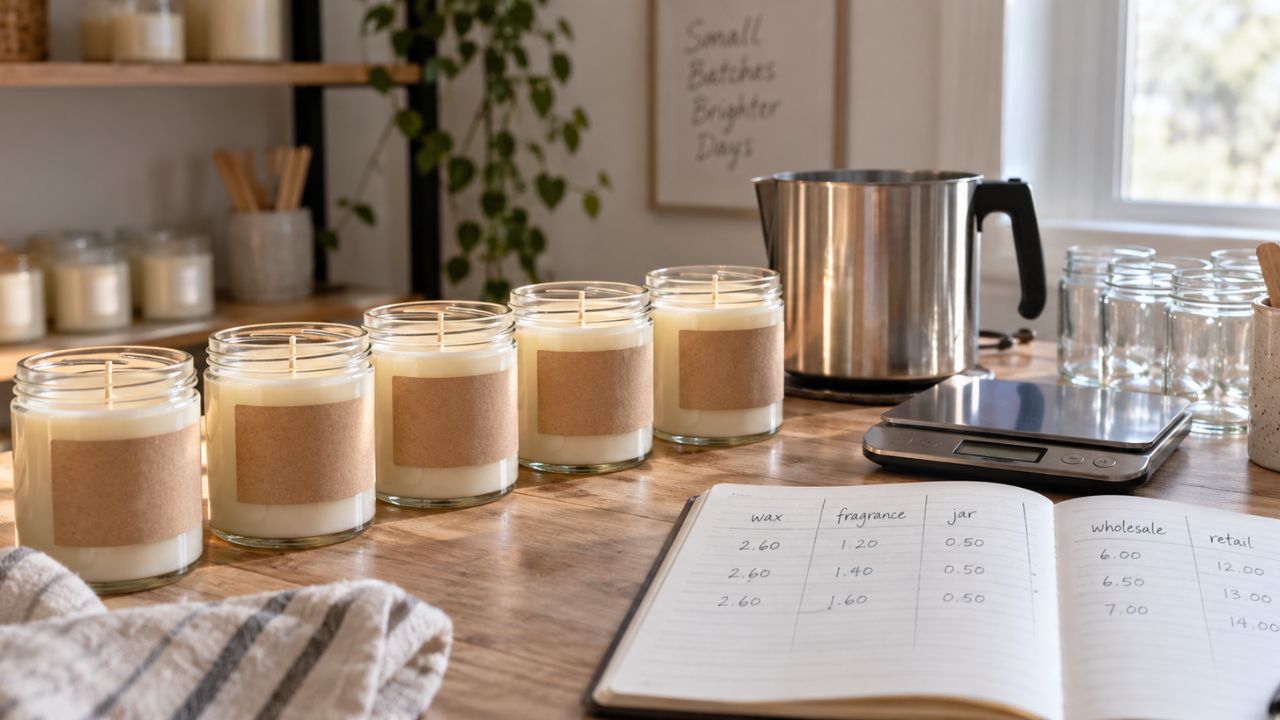
To price handmade candles for wholesale, add up the real cost of one finished jar, then set a wholesale price that still pays you after the shop takes its cut.
Most gift boutiques expect to pay about half of the suggested retail price and double it on the shelf. That is keystone pricing. If your wholesale number only covers wax and a jar, the order will look busy and still lose money.
Wholesale is a volume channel. The shop handles display, staff, and the shopper. You handle a lower price per candle. The math has to work at that lower price, not only on Etsy.
This guide walks US makers through a candle-specific cost sheet, the two formulas buyers expect, a full 8 oz example, and how to quote cases without undercutting your own stores.
How to Price Handmade Candles for Wholesale
Run two checks on every scent and size.
From your cost:
Wholesale price = True cost per candle ÷ (1 − your wholesale margin)
From the shelf:
Wholesale price = Suggested retail price × (1 − retailer margin)
For many specialty and gift shops, retailer margin starts near 50%, so wholesale is about half of MSRP. Both results should be close. If cost-based wholesale is higher than what the shop can pay, that candle is not ready for wholesale. Change the vessel, buy supplies in bulk, raise MSRP, or keep it as a direct-only item.
True cost is not “wax plus jar.” It is everything required to hand a sellable candle to a buyer.
Build true cost one candle at a time
Price a single SKU from a real batch, not from memory.
Materials
- Wax by weight in the jar, not the jar’s fluid ounces. An “8 oz” jar often holds about 6.5 to 7.5 oz of wax.
- Fragrance oil at your load. Many container candles use about 6% to 10% of wax weight. Cost that oil by the ounce you pour, not by the bottle you bought.
- Wick, wick sticker, and any dye
- Vessel and lid
- Brand label and a caution label
- Gift box, sleeve, dust cover, or tissue if the shop receives the candle ready to sell
Labor
Pay yourself an hourly rate, even if you work from home. Include measuring, melting, pouring, wick trimming, labeling, and packing. If a batch of 12 takes three hours at $20 per hour, labor is $5.00 per candle. Batching lowers this. One-off pours do not.
Waste and testing
Count the wick tests, the sinkholes you redo, and the jar that cracked. If 2 candles in 24 are unsellable, spread that cost across the 22 that ship.
Overhead, lightly
Studio electric, scales, and pouring pitchers belong here as a small per-candle slice. Do not bury your full rent in one 8 oz jar. Cover overhead with the margin on all wholesale units.
A traditional supplier rule of thumb is to charge about two times cost for wholesale and three to four times cost for direct sales. Use that only after cost includes labor and packaging, not wax alone.
Read the market before you lock MSRP
Shoppers do not pay “4 times your wax bill.” They pay what similar handmade candles cost in the stores you want.
CandleScience, a major US candle-supply company, groups a 7 oz candle roughly as mass market $8 to $15, mid-market $16 to $34, and prestige $35 and up. Handmade soy or coconut jars in boutiques usually sit in the mid or prestige band, not next to a grocery tealight.
Walk two local gift shops. Note size, vessel, and ticket. If every comparable 8 oz jar is $24 to $32, a $48 wholesale-backed MSRP will sit unsold. A $16 MSRP will not cover a heavy glass vessel and your time.
The National Candle Association notes that US candles sell through gift and specialty shops as well as mass retail, and that holiday months are a large share of the year. Seasonal scents need a wholesale price that still works after January markdowns.
Worked example: an 8 oz soy jar for boutiques
These figures are a teaching example. Swap in your invoices.
Materials for one candle
| Line | Amount |
|---|---|
| Soy wax (7 oz) | $1.10 |
| Fragrance oil (8% load) | $0.70 |
| Cotton wick and sticker | $0.18 |
| Glass jar and lid | $2.10 |
| Labels (brand + caution) | $0.35 |
| Box and tissue | $0.80 |
| Materials | $5.23 |
| Labor (12 min at $20/hour) | $4.00 |
| Waste and tests (allocated) | $0.40 |
| Light overhead | $0.50 |
| True cost | $10.13 |
You want about a 40% wholesale margin:
Wholesale = $10.13 ÷ 0.60 = $16.88, round to $17.00
A boutique using 50% keystone needs this MSRP:
MSRP = $17.00 ÷ 0.50 = $34.00
Check the shopper: $34 for an 8 oz handmade jar is mid to prestige. If your local shops cap out at $28, either cut true cost or skip those shops.
Profit to you at $17 wholesale: $17.00 − $10.13 = $6.87 per candle, before freight to the store and payment terms.
If you had priced wholesale at materials × 2 ($10.46), labor would vanish. That is the most common handmade-candle wholesale mistake.
Quote cases, not loose jars
Shops buy in cases. Pack so a shelf set looks finished.
Example line sheet:
| Item | Pack | Unit wholesale | Case total | Suggested retail |
|---|---|---|---|---|
| 8 oz soy jar | 6 | $17.00 | $102.00 | $34.00 |
| 4 oz votive | 12 | $8.50 | $102.00 | $17.00 |
Set a first-order minimum, such as $250 or two scents, so picking and packing are worth the trip to the post office.
Offer a small volume break only if cost falls. Example: 12 cases at $16.00 each. Recheck freight. Candles are heavy. Free shipping on a $102 case can erase the $6.87 unit profit.
State freight in one line. FOB origin means the shop pays the label from your studio. Prepaid means you built postage into wholesale.
Include one tester or a lid sample in the opening order if the buyer needs a burn test. Price that tester into the case or bill it. Unpaid testers are a discount.
Keep your website from undercutting the shop
If boutiques sell the 8 oz jar at $34, do not run it at $22 on Etsy every weekend. Retailers notice. They stop reordering.
A clean structure:
- Same MSRP everywhere
- Wholesale at about 50% of MSRP
- Site discounts that stay near a published MAP, if you use one
- Exclusive scents for wholesale if you want a web-only sale calendar
Consignment is not wholesale. The shop pays you after the candle sells and often keeps 40% to 60% of retail. Price consignment like wholesale risk, not like a favor.
Details that change candle wholesale math
- Cure time. Soy often needs days on the shelf before it ships. That is cash sitting in jars. Do not promise next-day wholesale if you pour to order.
- Fragrance load. A 10% load on a pricey oil can cost more than the wax. Recost every scent. A “signature” oil may need a higher wholesale than your house blend.
- Vessel upgrades. A $4 jar looks premium and can support a higher MSRP. It also wrecks margin if you leave wholesale at $17.
- Warning labels. Plan for a caution label on every unit. It is a cost line and a packing step.
- Seasonal leftover. Holiday collections that do not sell become January problems. Price them with room for a shop markdown, or sell them as a short preorder.
A sequence you can reuse this week
- Cost one 8 oz (or your core size) from the last batch, including labor and waste.
- Walk shops and write down three comparable tickets.
- Set MSRP inside that band if your cost allows it.
- Halve MSRP for a keystone wholesale draft.
- Confirm that draft still leaves you a real margin after true cost.
- Build a 6-pack case price, a minimum order, and freight terms.
- Print a one-page line sheet with scent, size, burn time, wholesale, MSRP, and case quantity.
If step 5 fails, fix the candle before you email a buyer. Wholesale volume will not repair a $10 cost behind a $12 wholesale price.
FAQs About How to Price Handmade Candles for Wholesale
Q. Should wholesale always be half of my Etsy price?
A. Wholesale should be about half of the price you want stores to charge, which should match a consistent MSRP. If your Etsy price is already a discount price, halving it will wipe out profit. Set MSRP first, then wholesale.
Q. Do I include my time in candle wholesale cost?
A. Yes. Pouring, labeling, and packing are work. If labor is missing from cost, a “profitable” wholesale order is unpaid labor at scale.
Q. What minimum order should I set?
A. High enough that packing and postage leave profit, low enough that a small gift shop can say yes. Many makers start around two cases or a set dollar floor, then adjust after a few shipments.
Q. How do I handle sales tax on wholesale candle orders?
A. Many sales to retailers are resale and may be exempt if you collect a valid resale certificate. Rules vary by state. Confirm with your state tax agency or a tax professional.
Conclusion
You price handmade candles for wholesale by costing the finished jar, including labor and waste, then setting a wholesale price a shop can keystone to a realistic MSRP. Half of retail only works if that half still beats true cost. Cost one core size from your last batch, compare it with local boutique tickets, and write the case price before you pitch a buyer.
Disclaimer: This article is general educational information for US candle makers. Supply costs, shop margins, freight, labeling rules, and sales-tax treatment vary and change. Examples are simplified. This is not accounting, tax, legal, or product-safety advice. Confirm figures with your invoices, your buyers, and qualified professionals when you need advice for your business.