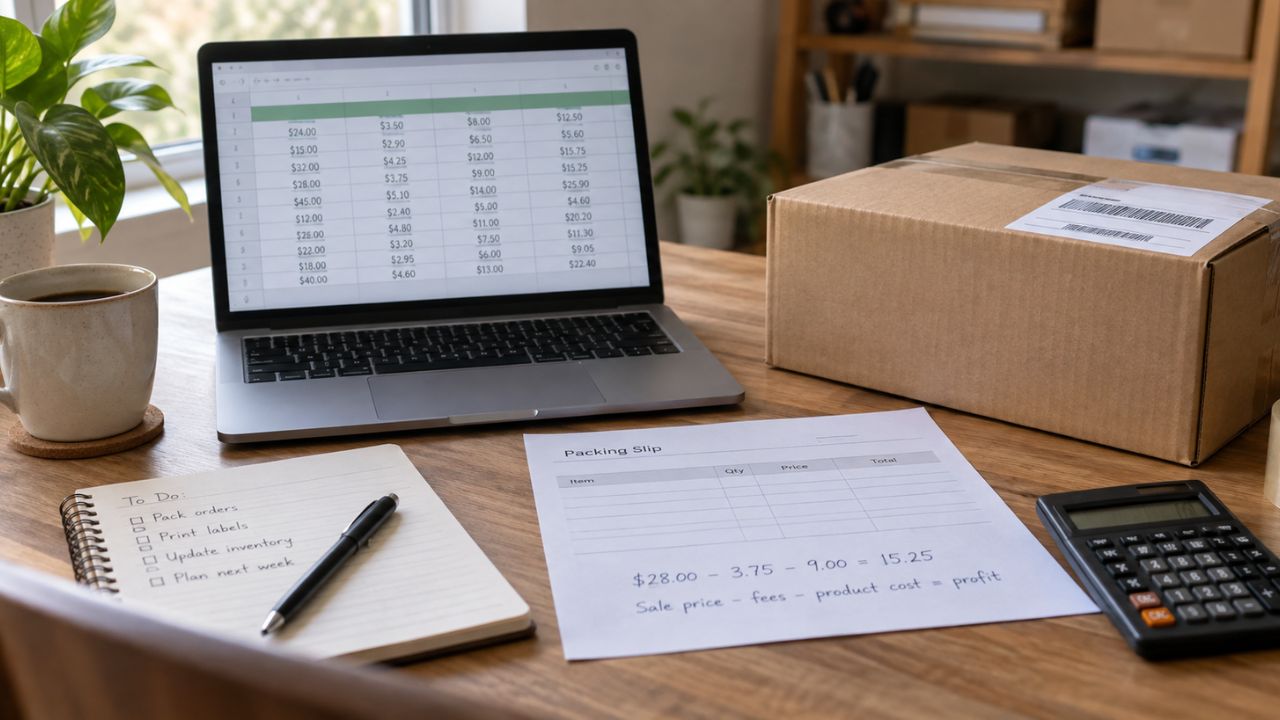
To calculate profit after marketplace fees, start with what the buyer paid you for the item and any shipping you charged. Subtract the marketplace’s cut, your product cost, and the shipping or fulfillment you actually paid. What is left is profit after marketplace fees. The payout in your seller account is not the same as profit.
Amazon, eBay, and Etsy each take a different slice, and they do not all apply that slice to the same number. Some fee the item price only. Others fee shipping and even sales tax. If you skip the fee base, your margin will look better than your bank deposit.
This guide gives US beginners one formula, the fee bases that matter, and a side-by-side example so you can price a listing before you buy inventory.
How to Calculate Profit After Marketplace Fees
Use this per-order formula:
Profit after marketplace fees = (Item price + shipping the buyer paid) − marketplace fees − product cost − shipping or fulfillment you paid − extras
Then:
Margin after fees = (Profit after marketplace fees ÷ Item price + buyer-paid shipping) × 100
Leave out sales tax the platform collects for the state. That money is not yours. Keep it out of revenue even when a platform uses it to calculate its percentage.
“Extras” means listing fees, promoted-listing ads, storage, and returns that belong to that sale. Skip rent and software until you judge the whole month.
What “marketplace fees” usually include
Each site uses different names. Group them so you do not miss a line.
- Referral or final value or transaction fee. A percent of the sale. This is the big one.
- Per-order or minimum fee. A flat dollar amount, such as eBay’s per-order fee or Amazon’s $0.30 minimum referral on many categories.
- Payment processing. Sometimes bundled (Amazon and eBay managed payments). On Etsy it is a separate 3% + $0.25 for many US shops.
- Listing or insertion fees. Etsy’s $0.20 listing fee. eBay insertion fees after your free listings run out.
- Fulfillment fees. Amazon FBA or Walmart WFS if the platform picks, packs, and ships. These are not the referral fee. Add them as shipping you paid.
- Optional ads. Amazon PPC, eBay Promoted Listings, Etsy Offsite Ads. Only subtract them when that order triggered the charge.
The fee you see in a blog table is a starting point. Open the live fee page or the fee preview in your seller account before you commit to a price.
The fee base is where sellers get the math wrong
A 15% fee on $40 is $6. A 15% fee on $40 plus $8 shipping is $7.20. Same rate. Different hole in your margin.
Amazon
The referral fee is a category percent of the total sales price, with a per-unit minimum on most categories (often $0.30). Most categories are 15%. Consumer electronics and computers are often 8%. Clothing and jewelry use tiers. Referral applies whether you ship the order (FBM) or Amazon does (FBA). FBA adds a separate fulfillment fee.
eBay
For most categories the final value fee is 13.6% of the total amount of the sale up to $7,500, then 2.35% above that, plus $0.30 per order at $10 or less or $0.40 above $10. eBay’s own example applies that percent to item price plus shipping plus sales tax. That is why the fee can look larger than 13.6% of the money you get to keep.
Etsy
The transaction fee is 6.5% of the listing price plus shipping and gift wrap you charge. Payment processing is extra. Offsite Ads add 15% or 12% only on orders Etsy attributes to its outside ads, capped at $100 per order. US shops do not pay Etsy’s country regulatory operating fee.
If you model every marketplace as “about 15% of the sticker price,” eBay and Etsy will surprise you whenever you charge shipping, and Amazon FBA will surprise you when the box is heavy.
How to calculate it in six steps
- Write the item price and any shipping the buyer paid. Do not add sales tax to revenue.
- Look up the category rate and the fee base on that marketplace. Confirm whether shipping and tax sit inside the percent.
- Add flat fees: per-order charges, listing fees, minimums.
- Subtract product cost for the units in that order.
- Subtract the label you bought, or the FBA / WFS fulfillment fee from the platform calculator.
- Subtract ads or Offsite Ads only if that order incurred them. The remainder is profit after marketplace fees.
If the remainder is negative, raising volume on that SKU and channel will not rescue it.
Worked example: one $40 item on three marketplaces
Same product. You paid $14 for it. You offer free shipping to the buyer. Your own USPS label would cost $7.00. You run no ads. No sales tax in the revenue line.
Amazon (you ship it, 15% Home & Kitchen style category)
| Line item | Amount |
|---|---|
| Item price (revenue) | $40.00 |
| Referral fee (15%) | −$6.00 |
| Product cost | −$14.00 |
| Your shipping label | −$7.00 |
| Profit after marketplace fees | $13.00 |
| Margin | 32.5% |
If Amazon fulfills it, drop the $7.00 label and subtract the FBA fulfillment fee from Seller Central’s revenue calculator instead. That fee depends on size and weight. It can be lower or much higher than $7.
eBay (most categories, no Store plan)
Fee base is $40.00 if the buyer paid no tax in this simple case.
| Line item | Amount |
|---|---|
| Item price (revenue) | $40.00 |
| Final value fee (13.6% of $40) | −$5.44 |
| Per-order fee | −$0.40 |
| Product cost | −$14.00 |
| Your shipping label | −$7.00 |
| Profit after marketplace fees | $13.16 |
| Margin | 32.9% |
If the buyer paid $8 shipping, eBay would fee $48, not $40. Your revenue would rise by $8, but so would the 13.6% line. Free shipping does not remove the fee. It just moves the dollars into the item price.
Etsy (US shop, no Offsite Ads on this order)
| Line item | Amount |
|---|---|
| Item price (revenue) | $40.00 |
| Transaction fee (6.5% of $40) | −$2.60 |
| Payment processing (3% + $0.25) | −$1.45 |
| Listing fee | −$0.20 |
| Product cost | −$14.00 |
| Your shipping label | −$7.00 |
| Profit after marketplace fees | $14.75 |
| Margin | 36.9% |
Same $40 item. Etsy kept more of the price in this no-ads case. Add a 15% Offsite Ads fee on a $40 order and Etsy takes another $6.00. Profit falls to $8.75. That is why a “cheap” marketplace can become the expensive one on advertised traffic.
These figures are teaching examples. Your category rate, FBA size tier, eBay Store discount, and tax line will move them. Check the live schedule before you buy a case pack.
How to set a price that survives the fee
Work backward when you know the cost and the fee rate.
Approximate price needed = (Product cost + shipping you pay + flat fees + target profit) ÷ (1 − fee percent)
Example: $14 cost, $7 label, $0.40 flat, $10 target profit, 13.6% eBay fee.
($14 + $7 + $0.40 + $10) ÷ (1 − 0.136) = $31.40 ÷ 0.864 = about $36.34.
Round to a price shoppers accept, then rerun the full table. If you also pay a percent on shipping or tax, the simple divider understates the fee. Use the platform’s fee preview when the listing is live.
A $0.30 Amazon minimum wrecks cheap items. Fifteen percent of a $1.50 spare part is $0.23, but Amazon still takes $0.30. On low-price goods the minimum, not the percent, sets your floor.
Common mistakes
- Pricing from the sticker and ignoring that eBay and Etsy may fee shipping.
- Treating the Amazon payout as profit before FBA, storage, and returns.
- Using last year’s eBay rate. Many older articles still quote 13.25%. The common US rate in current seller-center materials is 13.6% plus the per-order fee.
- Forgetting Etsy processing sits on top of the 6.5% transaction fee.
- Comparing Amazon 15% with Etsy 6.5% and calling Etsy “half the cost” without processing, listings, and Offsite Ads.
- Leaving sales tax in revenue. You do not keep it. Some platforms still include it in the percent.
A 15-minute habit that keeps you honest
Once a month, pick 10 settled orders from each channel. For each order write buyer-paid item plus shipping, the fees the platform deducted, product cost, and the label or FBA charge. Average the leftover. If one channel’s leftover per order is thin, raise price there, cut the SKU, or move that item to the channel whose fee base fits it.
Do this before a big restock. Marketplace fees are public. The surprise is almost never the published percent. It is applying that percent to the wrong total.
FAQs About How to Calculate Profit After Marketplace Fees
Q. Do marketplace fees include sales tax?
A. You should not count collected sales tax as your revenue. Some platforms, including eBay, still include tax in the number they multiply by the final value percent. That raises the fee without raising money you keep.
Q. Is Amazon FBA part of the referral fee?
A. No. Referral is the category commission. FBA is a separate pick, pack, and ship charge plus storage. Add both when Amazon fulfills the order.
Q. Which US marketplace takes the smallest fee?
A. It depends on the item and the extras. Etsy’s core stack is often lower on a quiet organic sale. Amazon can be cheaper on electronics at 8% until FBA lands. eBay sits in the middle on most categories and fees a wider base. Run the same SKU through each formula.
Q. Should I include promoted listings or PPC in this number?
A. Include them when that order caused the charge. Keep a second version of the math without ads so you can see whether the listing is viable on organic traffic alone.
Conclusion
You calculate profit after marketplace fees by taking item price plus buyer-paid shipping, then subtracting the platform’s percent and flat fees, your product cost, and the shipping or fulfillment you paid. The rate is only half the story.
The fee base is the other half, and it differs on Amazon, eBay, and Etsy. Open one recent payout and run this formula on it before you change a listing price.
Disclaimer: This article is general educational information for US sellers. Marketplace fee schedules, category rates, fulfillment charges, tax collection, and payout rules change and vary by account. Examples are simplified. This is not accounting, tax, or legal advice. Confirm current fees in your seller account and with a qualified professional when you need advice for your business.