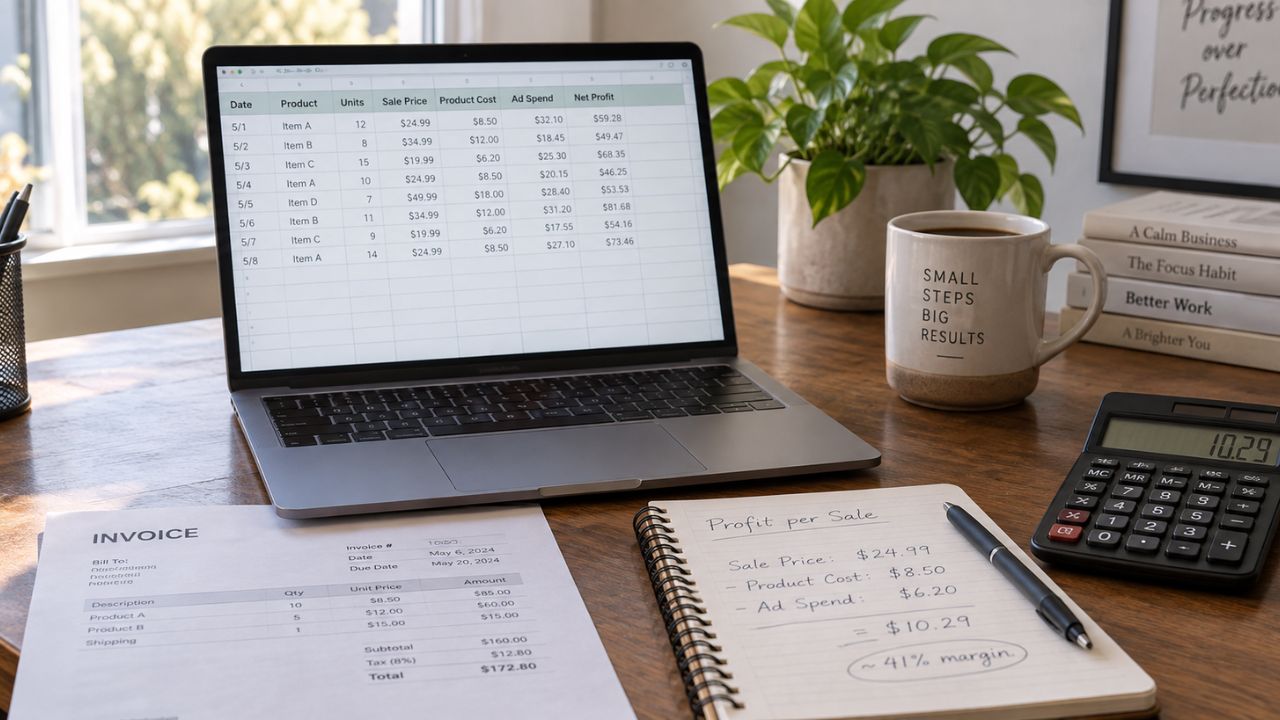
To calculate profit after advertising costs, take the money you collected from sales and subtract product costs, fulfillment costs, payment fees, and the ads you paid to win those sales. What remains is the profit those orders actually left. A high return on ad spend (ROAS) does not guarantee that number is positive.
ROAS only compares revenue to ad spend. It ignores the product, the box, the label, and the card fee. That is why a campaign can look like a winner in Meta or Google and still shrink the cash in your checking account.
This guide shows US beginners the per-order and monthly formulas, a full worked example, and the break-even ROAS that tells you when to scale ads or stop.
How to Calculate Profit After Advertising Costs
Use this formula when you want the real leftover on sales you paid to acquire:
Profit after advertising costs = Revenue − product cost − shipping and packaging − payment fees − other variable costs − advertising spend
As a percentage:
Profit margin after ads = (Profit after advertising costs ÷ Revenue) × 100
Revenue means what customers paid for products, after discounts, and before sales tax you collect for the state. Advertising spend means the media bill from Google, Meta, Amazon, TikTok, and similar platforms, plus commissions that rise with sales, such as affiliate payouts.
Do not mix in rent, salaries, or your monthly Shopify plan at this step. Those are overhead. First learn whether one advertised order makes money. Then judge the whole company.
Why ROAS is not profit
ROAS means return on ad spend:
ROAS = Ad-attributed revenue ÷ Ad spend
Spend $1,000 and get $3,000 in tracked sales. ROAS is 3x. That $3,000 is revenue, not profit. If product and shipping ate $2,400, you have $600 left before the $1,000 ad bill. After ads you are in the hole.
Amazon sellers see the same issue with ACoS (advertising cost of sales). ACoS is ad spend divided by ad sales. A 25% ACoS equals a 4x ROAS. It still says nothing about product cost or FBA fees.
Treat ROAS as a speedometer. Treat profit after advertising costs as the fuel gauge.
Costs to subtract before you touch the ad bill
Get these from invoices and payout reports, not from a guess.
- Product cost (COGS). Supplier invoice plus inbound freight and duties already in the unit cost.
- Shipping and packaging. The label you bought, the mailer, and pick-and-pack if a warehouse charges per order.
- Payment processing. Many US online checkouts charge about 2.9% plus $0.30 per card payment. Use your actual rate.
- Platform fees. Amazon referral and fulfillment fees. Etsy transaction fees. Extra Shopify fees if you use a third-party gateway.
- Return reserve. If 10% of orders come back and each return costs $15, that is $1.50 per order on average.
- Advertising spend. Media invoices plus sales-based affiliate or influencer commissions. Agency retainers can sit with overhead unless they scale directly with spend.
The U.S. Small Business Administration treats advertising as a real business cost and tells owners to compare marketing spend with the revenue it produces. That comparison only works if product and fulfillment costs are already in the picture.
How to calculate it in six steps
- Pull revenue for one order, one campaign, or one month. Use net sales after discounts and refunds. Leave sales tax out.
- Subtract product cost for the units sold in that same slice.
- Subtract shipping, packaging, and fulfillment for those orders.
- Subtract payment and marketplace fees.
- Subtract advertising spend that belongs to the same slice. For one order, that is often your customer acquisition cost (CAC): ad spend divided by new customers.
- Read the remainder. If it is negative, more of the same ads will lose more money.
You can do the same math as a stack. Revenue minus product cost is gross profit. Minus fulfillment and fees is contribution before ads. Minus ads is profit after advertising costs. Some finance teams call that last layer contribution margin after marketing. The name matters less than the order of subtraction.
Worked example: a $60 order and a $4,000 month
One advertised order
A customer pays $60 for an item on your website. You spent ads to get that click.
| Line item | Amount |
|---|---|
| Revenue | $60.00 |
| Product cost | −$18.00 |
| Shipping and packaging | −$9.00 |
| Card fee (2.9% + $0.30) | −$2.04 |
| Left before ads | $30.96 |
| Ad cost to win this order (CAC) | −$18.00 |
| Profit after advertising costs | $12.96 |
| Margin after ads | 21.6% |
ROAS on this order is $60 ÷ $18 = 3.3x. That looks healthy in an ads dashboard. After costs you kept $12.96, not $42.
Same store, one month
| Line item | Amount |
|---|---|
| Product revenue | $20,000 |
| Product cost | −$6,000 |
| Shipping and packaging | −$2,400 |
| Payment fees | −$680 |
| Left before ads | $10,920 |
| Google + Meta ad spend | −$5,000 |
| Profit after advertising costs | $5,920 |
| Margin after ads | 29.6% |
| Blended ROAS (MER) | 4.0x |
Blended ROAS here is total revenue divided by total ad spend, often called MER (marketing efficiency ratio). It includes organic and repeat orders, so it is usually kinder than platform ROAS. It is still not profit until you subtract product and fulfillment.
Find the ROAS that only breaks even
Break-even ROAS is the return you need so ads exactly cancel the money left after product and fulfillment. No profit. No loss.
Break-even ROAS = 1 ÷ contribution margin before ads
Contribution margin before ads is:
(Revenue − product cost − shipping − fees − return reserve) ÷ Revenue
In the $60 example, $30.96 ÷ $60 = 51.6%. Break-even ROAS is 1 ÷ 0.516 = 1.94x.
Any tracked ROAS below 1.94x loses money on that cost structure. A 3.3x ROAS clears the line. A 1.5x ROAS does not, even if the ads manager calls it “almost 2x.”
A quick map:
| Left after product and fulfillment | Break-even ROAS |
|---|---|
| 20% | 5.0x |
| 30% | 3.3x |
| 40% | 2.5x |
| 50% | 2.0x |
| 60% | 1.7x |
If you want a profit cushion, raise the target. To keep about 20% of revenue after ads when your pre-ad margin is 50%, you need ads to consume no more than 30% of revenue, which is about a 3.3x ROAS on fully advertised sales.
CAC cannot exceed what one order leaves
Customer acquisition cost is:
CAC = Advertising spend ÷ Number of new customers
The most you can pay and still break even on the first order is the dollars left after product, shipping, and fees. In the example that cap is $30.96. An $18 CAC leaves profit. A $35 CAC loses $4.04 on day one.
A first order can lose a little if you have proof that customers buy again soon. That is a separate, honest plan. It is not an excuse to ignore the first-order number.
The Small Business Administration’s break-even idea is the same logic at company level: price minus variable cost must cover the rest of the business. Ads that attach to each new sale are a variable cost of that sale.
Common mistakes that fake a win
- Judging a campaign by ROAS alone.
- Using list price instead of the discounted price the customer paid.
- Counting refunded orders as ad wins. You still paid for the click.
- Letting Meta and Google both claim the same sale, then adding those revenues together.
- Spreading one month of ads across last month’s leftover inventory sales, or the reverse.
- Forgetting Amazon’s referral and FBA fees before you set a break-even ACoS.
- Treating a 3x ROAS as “good” for every product. Thin-margin goods need a much higher ROAS.
What to do with the number
If profit after advertising costs is positive and stable, you can test a larger budget on the same offer.
If it is near zero, fix the offer before you spend more. Raise price, cut COGS, tighten free shipping, or stop discount codes that steal the margin ads need.
If it is negative, pause the weak campaign. Check creative, landing page, and audience. Do not “make it up on volume.”
For a habit that takes 20 minutes, pick last month. Write revenue, product cost, shipping, fees, and the sum of every ads invoice. Subtract once. That single remainder is more useful than any platform badge that says 4x.
FAQs: How to Calculate Profit After Advertising Costs
Q. Should I include organic sales in profit after advertising costs?
A. For the whole business, yes. Subtract total ad spend from total profit after product and fulfillment. For one campaign, use only the sales you can fairly tie to that campaign so you do not hide a losing ad inside healthy repeat orders.
Q. Are agency fees part of advertising costs?
A. Include them in the profit-after-ads figure when the fee is a percent of spend or billed only because you ran ads. A flat monthly retainer can be treated as overhead if it does not move with each extra dollar of media.
Q. How do discounts change the math?
A. A discount lowers revenue. Ad cost usually stays the same. A 20% off code on a $60 item drops revenue to $48 and can wipe out the $12.96 profit in the example if CAC does not fall with it.
Q. Is profit after advertising costs the same as net profit?
A. No. It is what is left after variable selling costs, including ads. Net profit also subtracts rent, payroll, software, insurance, and taxes. Use the first number to run ads. Use net profit to judge the company.
Conclusion
You calculate profit after advertising costs by subtracting product cost, fulfillment, fees, and ad spend from revenue. ROAS can look strong while that remainder is thin or negative, so set your target with break-even ROAS and a CAC cap, not with a generic 3x rule. Pull last month’s sales and ads invoices and run the formula once before you raise the budget.
Disclaimer: This article is general educational information for US readers. Ad auctions, platform fees, attribution, tax treatment of advertising, and your cost structure vary by business and change over time. This is not accounting, tax, or legal advice. Confirm figures with your invoices, ad accounts, and a qualified professional when you need advice for your situation.