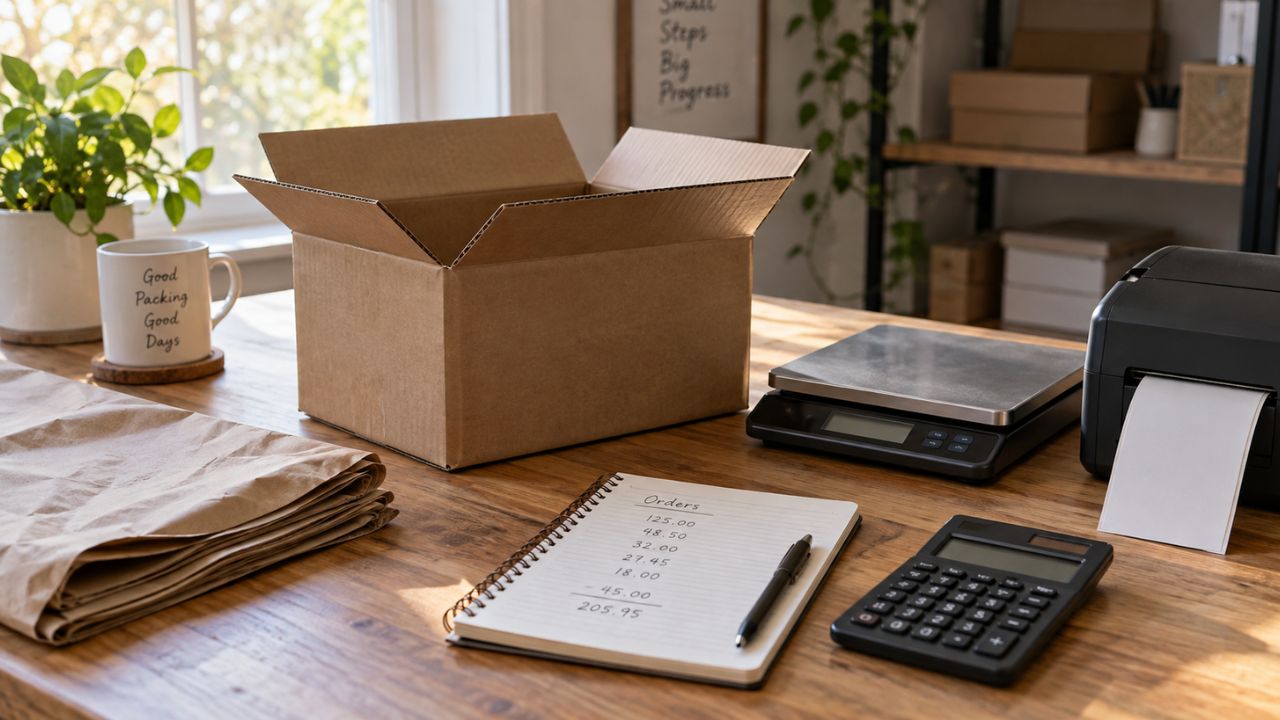
To calculate profit after free shipping, start with the price the customer paid for the product. Then subtract every cost that order actually created: product cost, packaging, the shipping label you bought, payment processing, and any marketplace or platform fees. What is left is the profit on that order.
Free shipping is not free for you. The customer sees $0 at checkout. You still pay the carrier. That is why a sale can look fine on the product page and still leave almost nothing in the bank.
This guide walks US beginners through the per-order math, a full worked example, and a simple way to set a free-shipping threshold so low-value orders do not wipe out your margin.
How to Calculate Profit After Free Shipping
Use this per-order formula when the buyer does not pay for shipping:
Profit after free shipping = Product price − product cost − packaging − shipping you pay − payment fees − platform fees
If you also want a percentage:
Profit margin after free shipping = (Profit after free shipping ÷ Product price) × 100
Do this on one real order first. A monthly revenue number hides the problem. A $32 order with an $8.50 label behaves very differently from a $90 order with the same label.
What free shipping changes in the math
When a customer pays shipping, your revenue is the product price plus the shipping charge. When shipping is free, revenue is only the product price. Your costs barely change. You still buy the label, the box, and the tape.
That gap is the whole issue. Shipping is mostly a fixed cost per box. A low order value cannot absorb it. A higher order value can.
Shoppers notice shipping at checkout. Extra costs such as shipping, tax, and fees are one of the top reasons US online shoppers leave a cart. That is why so many stores offer free shipping. The offer can help conversion. It only helps profit if the order is large enough to cover the label.
Costs to include every time
Pull the numbers from invoices and label history, not from memory.
- Product cost (COGS). What you paid the supplier for the item in that order, including inbound freight and import fees already baked into the unit cost.
- Packaging. Box or mailer, void fill, tape, insert, and any branded sleeve.
- Outbound shipping. The postage or carrier charge you actually paid. Use the commercial rate from your shipping software, not the Post Office counter price.
- Payment processing. Common US card rates are about 2.9% plus $0.30 per online order on many basic ecommerce plans. The exact rate depends on your processor and plan.
- Platform or marketplace fees. Shopify does not take a percent of the item if you use Shopify Payments. Amazon, eBay, and Etsy usually take a referral or transaction fee on the sale. Some marketplaces also fee the shipping amount if the buyer paid it.
- Return reserve (optional but smart). If 10% of orders come back and a return costs you $12 in labels and handling, that is $1.20 per order on average.
Skip rent, software subscriptions, and your own salary in this per-order view. Those are overhead. They matter later. They do not tell you whether one free-shipping order made money.
USPS Ground Advantage retail prices start at $7.90 at a Post Office, with lower commercial rates if you buy the label online. Your real cost will also move with weight, zone, box size, and peak-season surcharges. Always use the last label you paid, not a national average.
How to calculate it in six steps
- Write down the product price the customer paid, after any discount code. Do not add sales tax you collect for the state. That tax is not yours.
- Subtract product cost for the units in that order.
- Subtract packaging for that order.
- Subtract the shipping label cost. If you shipped two boxes, subtract both labels.
- Subtract payment processing. For a 2.9% + $0.30 rate, that is (price × 0.029) + 0.30.
- Subtract marketplace fees, if any. The remainder is profit after free shipping.
If the result is negative, that order lost money. Raising volume will not fix a negative per-order number. It will multiply the loss.
Worked example: a $32 order with free shipping
Imagine you sell a $32 item from your own US website. The customer pays $32. You offer free shipping.
Your costs on that order:
| Line item | Amount |
|---|---|
| Product price (revenue) | $32.00 |
| Product cost | −$12.00 |
| Packaging | −$1.50 |
| Shipping label you pay | −$8.50 |
| Card fee (2.9% + $0.30) | −$1.23 |
| Profit after free shipping | $8.77 |
| Margin | 27.4% |
Now run the same order if the customer paid $6.99 for shipping and your label still cost $8.50.
| Line item | Amount |
|---|---|
| Product price | $32.00 |
| Shipping charged to customer | +$6.99 |
| Total revenue | $38.99 |
| Product cost | −$12.00 |
| Packaging | −$1.50 |
| Shipping label you pay | −$8.50 |
| Card fee on $38.99 | −$1.43 |
| Profit | $15.56 |
| Margin on total revenue | 39.9% |
Free shipping cut profit by $6.79 on the same product. That is almost the whole shipping charge the customer no longer pays, minus a slightly lower card fee.
The lesson is not “never offer free shipping.” The lesson is that $32 was a thin order for an $8.50 label. The same store can still offer free shipping on a larger cart.
How to find a free shipping threshold
A threshold is the minimum order total that qualifies for free shipping. Set it high enough that the extra product margin covers the label.
First find gross margin on the product, before shipping and card fees:
Gross margin % = (Product price − product cost) ÷ Product price
In the example, ($32 − $12) ÷ $32 = 62.5%.
A simple planning formula many stores use is:
Threshold = current average order value + (average shipping cost ÷ gross margin %)
If your average order is $32, shipping is $8.50, and gross margin is 62.5%:
$32 + ($8.50 ÷ 0.625) = $32 + $13.60 = $45.60
Round to a clean number shoppers remember, such as $49. Then test it. If most carts already clear $49, the threshold is not doing much. If almost no cart reaches it, the bar is too high.
You can also ask a tighter question: how large must one order be before gross profit covers the label?
Shipping breakeven order value = shipping cost ÷ gross margin %
$8.50 ÷ 0.625 = $13.60. Any order below that cannot cover shipping from product margin alone. Most real stores also pay card fees and packaging, so treat $13.60 as a floor, not a target.
The U.S. Small Business Administration uses a related idea called contribution margin: price minus the variable cost of that sale. Shipping you absorb is a variable cost of that order. If contribution after shipping is negative, extra sales make the business worse, not better.
What to do if free shipping shrinks margin
You have four practical levers. You can use more than one.
Raise the product price. Bake part of the label into the sticker price so “free shipping” is prepaid by the customer. Be honest in your own books. The shipping cost did not disappear.
Require a minimum order. This is the threshold method above. It works when customers will add a second item to qualify.
Cut the label cost. Buy commercial postage through shipping software. Use a poly mailer instead of a large box when the product allows it. Compare USPS, UPS, and FedEx on the same package, because the cheapest carrier changes with weight and zone. Watch peak-season add-ons. USPS has used temporary holiday price changes on Ground Advantage and Priority Mail.
Limit free shipping by method. Offer free Ground only. Charge for expedited. Exclude Alaska, Hawaii, and PO Boxes if those lanes cost more than your mainland average.
If you sell on Amazon with Fulfillment by Amazon, do not copy this website formula blindly. Prime looks like free shipping to the shopper, but you pay Amazon fulfillment and referral fees instead of buying your own USPS label. Run Amazon’s fee preview on that SKU.
Common mistakes that hide the real number
- Using the retail Post Office rate when you actually print discounted commercial labels, or the reverse.
- Forgetting the $0.30 flat processing fee. On a $20 order it is more painful than on a $80 order.
- Ignoring dimensional weight. A light item in a big box can be billed as a heavier package.
- Averaging one cheap local label with expensive coast-to-coast labels, then pricing as if every order ships for the cheap rate.
- Counting a refunded order as a normal free-shipping win. You may pay postage both ways.
- Looking only at monthly sales. Ten $25 free-shipping orders can lose money while two $80 orders look fine in the same week.
A quick check you can reuse
Keep a one-line note for every sales channel:
Price − COGS − pack − label − fees = profit after free shipping
Update the label number when carrier rates change. Recheck after a packaging change. Recheck when you run a 20% off sale, because a discount lowers the price while the label stays the same.
If you want one next action today, open your last 20 fulfilled orders. Write the product price and the label cost for each. Circle any order where the label was more than 15% of the price. Those are the carts your free-shipping rule should not cover without a higher threshold or a higher price.
FAQs About How to Calculate Profit After Free Shipping
Q. Does free shipping include packaging and handling?
A. Not unless you add those costs yourself. “Free shipping” only means the customer paid $0 for delivery. Packaging, tape, and pick-and-pack labor are separate and should come out of profit.
Q. Should I calculate profit before or after sales tax?
A. After removing sales tax from the order total. Sales tax you collect is money you owe the state. It is not revenue and it should not be in the profit formula.
Q. How do discounts change profit after free shipping?
A. A discount lowers revenue. The label cost stays the same. A 20% off code on a $32 item drops revenue to $25.60 and can erase most of the $8.77 profit in the example above.
Q. Is profit after free shipping the same as net profit for the whole business?
A. No. Per-order profit after free shipping is a contribution figure. Your business still has rent, apps, ads, wages, and returns. Use the per-order number to price shipping. Use a full profit-and-loss statement to judge the company.
Conclusion
You calculate profit after free shipping by taking the product price and subtracting product cost, packaging, the label you paid, and processing or marketplace fees. The customer’s $0 shipping line does not cancel your carrier bill.
Run the formula on real orders, then set a threshold or a higher price so the average cart can carry that bill. Your next step is to price one recent order this way before you change the shipping setting in your store.
Disclaimer: This article is general educational information for US readers. Shipping rates, processor fees, marketplace fees, and tax rules change and vary by carrier, plan, product, and state. Your costs and results will differ. This is not accounting, tax, or legal advice. Confirm figures with your invoices, your sales channels, and a qualified professional when you need advice for your business.